Best 3D Animation Software in 2026
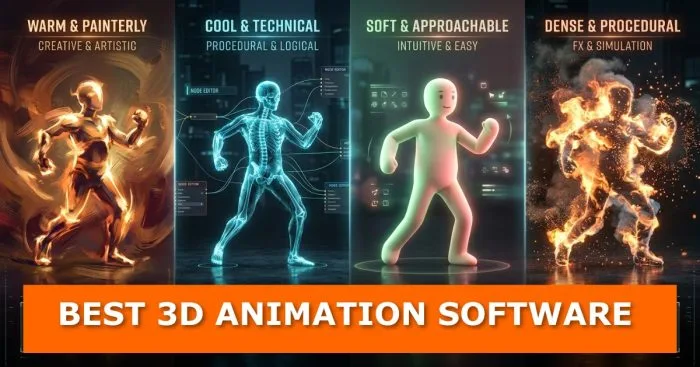
One of the most common questions I get is: what software do you use? The honest, current answer is Blender for sculpting, texturing, rigging, animation, and rendering — but “what should you use” depends entirely on your budget, your goals, and whether you enjoy the particular flavor of pain that comes with learning node graphs. Here’s an updated, no-fluff breakdown of the major 3D animation software options in 2026, what they actually cost now, and who each one is really for.
The short version from a couple of years ago still holds up surprisingly well: Maya for studio jobs, Cinema 4D for motion graphics, Blender for everyone else. What’s changed is the pricing, the feature sets, and the fact that two more programs deserve a seat at this table now. Let’s get into it.
1. Autodesk Maya
Maya remains the industry standard for character animation, rigging, and VFX pipelines. If your goal is to work at a major studio, knowing Maya still opens doors and makes collaboration easier, since most large pipelines are built around it.
Pros:
- Powerful modeling, rigging, animation, and rendering tools, including the integrated Arnold renderer
- Still the most widely used option in professional studios, making it a strong career investment
- Growing set of AI-assisted features, including MotionMaker for generating character motion from a few keyframes, and an ML Deformer for fast, interactive character deformation
Cons:
- Steep learning curve — plan on formal training or a lot of patient tutorial-watching
- Expensive, and the price keeps creeping upward year over year
Pricing:
- Around $255/month
- Around $2,010/year
- Around $6,025 for a three-year term
- Maya Indie (for individuals or small studios earning under $100,000/year) runs closer to $305–330/year, a much friendlier entry point if you qualify
Try Maya for free: Download trial version
2. Maxon Cinema 4D
Cinema 4D remains the friendliest on-ramp into professional 3D for anyone coming from a motion graphics or After Effects background. If you already think in keyframes, layers, and compositing, the jump to Cinema 4D’s MoGraph toolset feels natural rather than intimidating.
Pros:
- Easy to learn relative to Maya or Houdini, with a genuinely gentle learning curve
- Fast, GPU-accelerated rendering — Redshift now comes bundled with every Cinema 4D subscription at no extra cost
- Seamless integration with Adobe After Effects via Cineware
- Recently expanded to Windows on Arm, with an iPad version on the way
Cons:
- Still a subscription-only product — Maxon dropped perpetual licenses back in 2024
- Less common in big feature-film studio pipelines compared to Maya or Houdini
Pricing:
- Around $69.91/month billed annually (about $839/year), or $109/month billed monthly
- The Maxon One bundle, which adds ZBrush, Redshift, and Red Giant, runs higher but consolidates several subscriptions into one
Try Cinema 4D: Download trial version
3. Blender
Blender is completely free and open-source, and it has quietly stopped being “the free option” and started being simply one of the options. It handles modeling, sculpting, texturing, rigging, animation, and rendering in a single download, with zero subscription fees standing between you and a finished shot.
Pros:
- Free to use, forever, with no subscription fees
- All-in-one solution covering the entire pipeline from blocking out a scene to final render
- Actively developed on a public roadmap, currently on version 5.1.2 with 5.2 LTS due in July 2026
- Enormous community, with a constant stream of free tutorials and addons that extend what’s possible
Cons:
- Still not the default pipeline at the biggest studios, though that gap keeps shrinking
- Because it does everything, mastering any one discipline inside it takes real time investment
Try Blender for free: Download here
4. SideFX Houdini — the one this list used to skip
No animation software roundup is complete without Houdini, and honestly, the earlier version of this article should have included it. Houdini is the procedural, node-based powerhouse behind most of the big-budget destruction, fire, smoke, fluid, and crowd simulation work you see in film and high-end games. Its node-based workflow means almost everything you build is reusable and endlessly tweakable, which is either the most satisfying or most maddening thing about it depending on your patience for wiring nodes together.
Pros:
- Unmatched procedural simulation tools for fire, fluids, destruction, and crowds
- Houdini Indie makes the full FX toolset available to solo artists and small studios for a fraction of commercial pricing
- Deep integration with game engines and other DCCs through Houdini Engine
Cons:
- Famously steep learning curve, even by 3D software standards
- Full commercial licenses are expensive — Houdini FX runs around $4,495 for a node-locked perpetual license
Pricing:
- Houdini Apprentice: free, for non-commercial learning, with watermarked renders
- Houdini Indie: roughly $269/year for artists and small teams earning under $100,000/year
- Houdini FX (full commercial): thousands per seat, either as a perpetual license or annual subscription
Get it here: sidefx.com
5. Where AI-assisted animation fits into all this
If you’ve been keeping up with the AI side of creative tooling, you’ve probably noticed that “animation software” no longer means just the programs above. Real-time AI animation tools like NVIDIA Ardy are starting to let creators generate believable motion on surprisingly modest hardware, and Blender’s growing MCP-based pipelines mean you can now hand off entire sculpting-to-rendering workflows to an AI assistant working alongside you inside the same scene. None of this replaces learning Maya’s rigging tools or Houdini’s simulation nodes, but it’s quietly changing how much of the grunt work you have to do by hand before you get to the creative decisions. Worth keeping an eye on if you’re choosing a pipeline to invest years of your life into.
Final thoughts
Regardless of which software you choose, animation principles remain the same. Understanding concepts like anticipation, ease-in and ease-out, and secondary action will make your animations stand out no matter which timeline you’re scrubbing through. The best software is the one that fits your workflow, your budget, and your goals, not the one with the flashiest splash screen. If cost is a real constraint, Blender plus the right addons will get you further than most people expect. If a studio job is the goal, Maya is still the safest long-term bet, with Houdini as a serious complement if simulation work interests you.
Tell us where you landed
What software are you using or considering, and did Houdini earning a spot on this list finally settle an old argument in your studio? Let us know in the comments below. If you found this useful, share it with a fellow animator who’s still deciding, and check out our full library of Blender tutorials for the hands-on follow-up to everything mentioned here.

What do you think?
Join the Conversation